

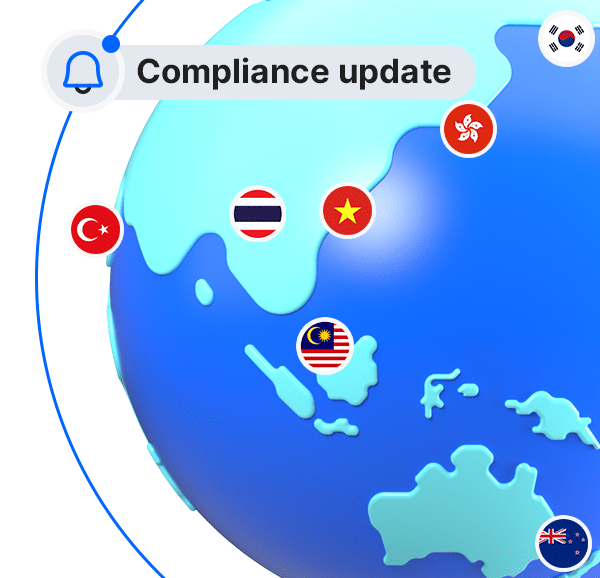
Did you know that CloudPay regularly updates a library of country tips and payroll guides, covering more than 90 territories around the world?
These guides cover all the key facts you need to know around running payroll in a particular country, from overtime and minimum wage, through sick pay and maternity leave, to income tax and social security.
Of course, every country’s approach to payroll and employment law is different, and they’re all liable to make changes for a host of reasons: changes in government, incentivizing employment, wider economic influences, and so on. And it’s for that reason that we regularly update these guides, so that you can get the latest information to inform your payroll process development.
To round off the final quarter of 2025, we’ve picked out some of the key changes that have emerged in the last few months, and some of the biggest developments across the year as a whole.
What’s changed in the last months of 2025?
Some of the biggest alterations that have come into force through the latter portion of 2025 include:

Malaysia: enhanced cover for foreign workers
As of October 1, contributions to the Employees Provident Fund are required to be made for foreign employees, although at 2% each by employer and employee, the rate is still lower than for Malaysian workers. Additionally, an increased minimum wage of RM 1,700 per month (approx. £315; $410; €355) has been rolled out in two phases over the course of the year.
Read our full Malaysia payroll guide here, just updated.

Turkey: Minimum wage soars
The continued high rates of inflation in Turkey are having major effects in several areas. Minimum wage and severance pay caps are being revised upwards on a regular basis, with the minimum wage rising by more than 600% in the space of just four years. There are also substantial revisions to income tax rates and/or thresholds expected to be introduced in the first part of 2026.
Read our full Turkey payroll guide here, just updated.

Hong Kong: part-time threshold redefined
New legislation has redefined the threshold at which a part-time worker is considered to have a ‘continuous contract’, ensuring that they are legally viewed in the same way as a full-time worker. As of January 2026, this threshold will be 17 hours worked per week, or 68 hours over a four-week period.
Read our full Hong Kong payroll guide here, just updated.
What have been the most notable changes this year?
Looking at the last 12 months as a whole, there have been some big alterations that have had a real impact on payroll, including in some of the world’s biggest economies and job markets:

India: major labour overhaul
The world’s most populous country is in the process of introducing sweeping labor reforms and rule simplification, across wages, industrial relations, social security, and occupational health and safety. These are now in force for businesses employing over 500 people, but will be rolled out to all businesses by 2027.

United Kingdom: employer costs increase
The UK government introduced revisions to minimum wage and National Insurance contributions in April, at the start of the 2025/26 financial year. The full minimum wage is now £12.21 per hour (approx. $15.40; €14.70), while employers are now required to make NI contributions of 15% on all earnings over £5,000 per year (approx. $6,330; €6,030).

United States: social security cap jumps
The wage bases across which social security contributions need to be made are still increasing year-on-year. For 2026, it will increase to $184,500 per year (approx. £139,700; €158,800), with employers and employees each needing to make contributions of 6.2% on all earnings up to that threshold.

Czech Republic: Parental rights expanded
New legislation has given parents more flexibility around their parental leave entitlements. Employees are now entitled to take their job back if they return to work before their child reaches two years old. The length of time employers can hire maternity or parental leave cover has also been extended from three years to nine.

Tunisia: higher tax for big earners
A new set of income tax thresholds took effect at the start of 2025, with more bands, and a greater difference between taxation of higher and lower earnings. All earnings of over TND 70,000 per year (approx. £18,000; $23,700; €20,400) are now subject to 40% income tax. The personal allowance for the first TND 5,000 earned per year remains in place (approx. £1,280; $1,700; €1,460).


Table of Contents
- What’s changed in the last months of 2025?
- Malaysia: enhanced cover for foreign workers
- Turkey: Minimum wage soars
- Hong Kong: part-time threshold redefined
- What have been the most notable changes this year?
- India: major labour overhaul
- United Kingdom: employer costs increase
- United States: social security cap jumps
- Czech Republic: Parental rights expanded
- Tunisia: higher tax for big earners
- In summary: aiming at a moving target
- In summary: aiming at a moving target