

Building a
Business case
For Global Payroll Transformation
Helping you engage stakeholders to elevate payroll
as a strategic business advantage
Introduction
As your organization expands and navigates the complexities of a changing global workforce, the demand for operational excellence intensifies. Payroll, a critical yet often underappreciated function, faces unprecedented challenges.
Your payroll operations are at a tipping point, and without strategic intervention, the path forward may grow increasingly difficult.
So, you require a robust plan. A plan not just for change, but one that aligns seamlessly with the vision of your organization’s leadership – a compelling business case for payroll transformation.
This guide is designed to help you craft that plan.

Your payroll needs a transformation
Of course, as a payroll leader, you’re well aware of the challenges your payroll operations face: legacy systems that deliver inadequate data; manual processes and human error that drain time and resources; and a lack of visibility into global payroll performance that hampers strategic decision-making. The list goes on.
Payroll is barely keeping pace with itself, let alone the needs of the rapidly expanding global organization you now manage.
What was once a fitting technological solution has been outstripped by the scale and complexity of your business.
Your payroll needs a transformation – to achieve this, securing organizational leadership buy-in is crucial, and often, this is far easier said than done.
As an advocate for change in your payroll operations, you understand what improvements are necessary. However, to achieve these, you need to construct a compelling business case that shifts the focus of the business and key stakeholders from the initial costs of change management and implementation to the long-term benefits of a game-changing payroll strategy.
73%
of payroll leaders consider “evolving payroll technology to ensure future-ready growth and scalability” a top objective in global payroll.1

This guide has been designed to
empower you to drive your
organization forward,
providing the insights and
tools necessary to garner
widespread business buy-in.
You’ll be able to clearly demonstrate the substantial costs associated with current inefficiencies and outline the tangible business advantages and risk-mitigation achievable through a global payroll transformation.
Over the following pages, we’ll explore how to shape a sound business case for transformation, by:
Identifying and quantifying critical payroll challenges
Developing a strategic vision for global transformation
Quantifying the future impact of optimized payroll operations
Mapping a process for implementation
Convincingly presenting the case to key business stakeholders
We’ll share insights on how to effectively gather data that gets noticed, provide best practices on addressing common objectives and business concerns – and even provide you with an RFP guide and template to accelerate your own vendor evaluation process. When the biggest obstacle to any enterprise software transformation is switching your businesses cost perceptions, the cost of doing nothing becomes an extremely powerful tool. Now is the time to put it to work, building a business case for future-proofed transformation that aligns global growth with your global payroll. And it all starts with identifying your payroll’s biggest pain points…

Before we get going, think about the decision-makers you’re creating the business case for, and ask yourself:
• What are their strategic priorities?
• What are their pain points?
• How aware are they of our current payroll challenges?
Whether it’s improving efficiency, reducing costs, enabling new territory growth or empowering stronger decision-making, aligning your approach with the organization’s broader strategic objectives and challenges is critical in moving the conversation from ‘how much will this cost us?’ to ‘how much value will this give us?’.


Where to next?
Ready to continue?
Dive into Understanding Your Payroll Pain Points
(est read time 5 minutes).
Or use the navigation bar above to jump to the chapter that best fits your payroll transformation needs.
Understanding your
payroll pain points
Revealing the hidden costs of your current payroll system
It’s not easy to see the bigger picture when you’re delivering day-to-day, but that’s exactly what you need to do with your current payroll system.
You need to take a step back so you can see the whole; this will enable you to identify your process pain points and the impact they have on delivery – and their potential consequences on the wider business.
Running global payroll is complex. Across borders and language barriers, traversing a variety of regulations and remuneration types, there’s always a new challenge waiting in the wings. What is the difference between a unified, streamlined global payroll solution and an outdated manual one?
Knowing where that next challenge may come from – and being able to handle it with speed and certainty is crucial.

45%
of payroll leaders said the “lack of visibility into payroll operations for informed decision-making” was a significantly difficult challenge.2
The foundation of your business case should be built on the challenges you have in your current payroll system; challenges that are causing risks (actual or potential) not only to your internal operations, but to the strategic direction of the business.
With that in mind, you should view your payroll pain points through two lenses–one operational and one strategic:
Operational
Consider the impact on the payroll function itself – productivity, process efficiency, resource utilization, security and system limitations, technology constraints, and analytics and reporting accuracy to name just a few.
Strategic
Define the consequences of those operational impacts on the wider business – increased costs, heightened regulatory risks, non-compliance penalties, reduced decision-making speed, and recruitment and retention risks (among others).
While organizations can be largely satisfied with their current third-party payroll provider,
survey respondents believe there are many areas for improvement.
Which of the following do you consider the top areas of focus or improvement relating to payroll provider services?3
Here are some of the most common pain point areas to explore
Inefficient manual processes
Accelerate and automate
Data integration issues
Complex compliance needs
Reporting and analytics limitations
Data integration issues
Most current payroll relies heavily on manual processes that are time-consuming, prone to human error and unscalable as the company continues to grow into new territories. Payroll teams spend too much time managing day-to-day administration, which limits their ability to focus on value-adding initiatives and innovation.
Replace manual touchpoints and remove repetitive work by streamlining your processes with global automation. Focus your team on strategic tasks and give them the time back to do what matters most: moving the needle on value-adding initiatives.
With disparate systems and processes working across multiple countries and regions, integrating payroll data into a centralized platform is inefficient at best – and at worst, not even possible. Even when data is imported, it’s often inconsistent and inaccurate, requiring yet more manual intervention and hours spent rectifying.
Managing multi-country payroll means navigating complex varying tax and compliance requirements. Without a centralized, global view supported by in-region expertise, global payroll becomes a time-consuming maze of compliance challenges and potential penalties just waiting to happen.
With multiple processes lacking standardization and working with inconsistent data, gaining trusted insights to support strategic decision-making is severely limited. Reporting stays reactive and analytics remain far from real-time, keeping payroll behind the curve and unable to support strategic growth planning.
Delays and inaccuracies in payroll processing not only cause frustration within payroll teams – they ripple out to the wider employee experience, too. Late and incorrect pay all play their part in eroding the employee experience and increasing dissatisfaction across the business.
76%
of payroll, HR and finance leaders said that technology has an ‘extreme’ or ‘significant’ impact on adhering to compliance requirements.4

Identify your global payroll’s
current pain points and the
impact they’ll have on
your ability to support
the organization’s
strategic objectives
– both today and in the future.
They are the foundation of your transformation business case.


Where to next?
Ready to shape the future?
Dive into Crafting
your vision for change
(Est read time 4 minutes).
Or use the navigation bar above to jump to the chapter that fits your needs, like Quantifying the impact.
Crafting your vision for change
Reshaping how you navigate the world (and your payroll).
Understanding the complexities of country-specific payroll compliance can feel like an uphill battle. Every time you grow into a new region, back to the start you go. Except now, you’re learning an entirely new set of regulations, requirements, and cultural customs.
Managing global payroll compliance can become a nightmare for payroll leaders in this context, let alone for the wider business. Slowing down new country rollouts and increasing exposure to new (and unknown) in-country regulation risks and penalties shouldn’t be the norm – unfortunately, without country-specific knowledge and expertise on-hand to help you navigate and communicate effectively, that’s often the case.
Getting it right requires an assessment of your current payroll regions as well as where it could be in the future – and mapping out the challenges and blockers prevalent in each region, alongside the expertise you’ll need to overcome them.
Including this in your business case does two things: it communicates future scalability challenges with the ‘as is’ state of your current payroll operations, while showcasing how they could be mitigated with the right approach and solution in place.

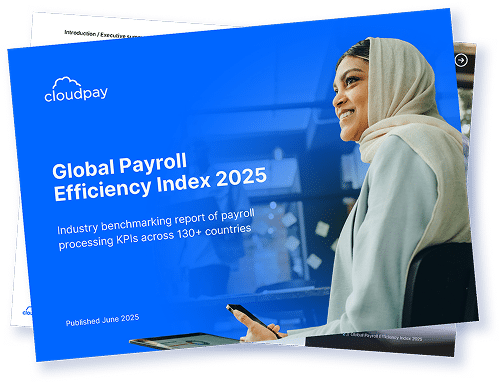
In its fifth edition for 2024, CloudPay’s Global Payroll Efficiency Index (PEI) maps out payroll performance for over 130 countries.
Based on more than one million payslips processed in a calendar year, the PEI offers critical insight into the most and least complex countries to run payroll in; extremely valuable when building out a world view of current and future payroll operations.
First time approvals
The first-time approval (FTA) rate is a good benchmark figure for data input processes, gross-to-net calculations, and their accuracy.
A high FTA rate generally means that payroll processes are efficient, that the data involved is of good quality, and that payroll calculations are sound.

PEI matrix
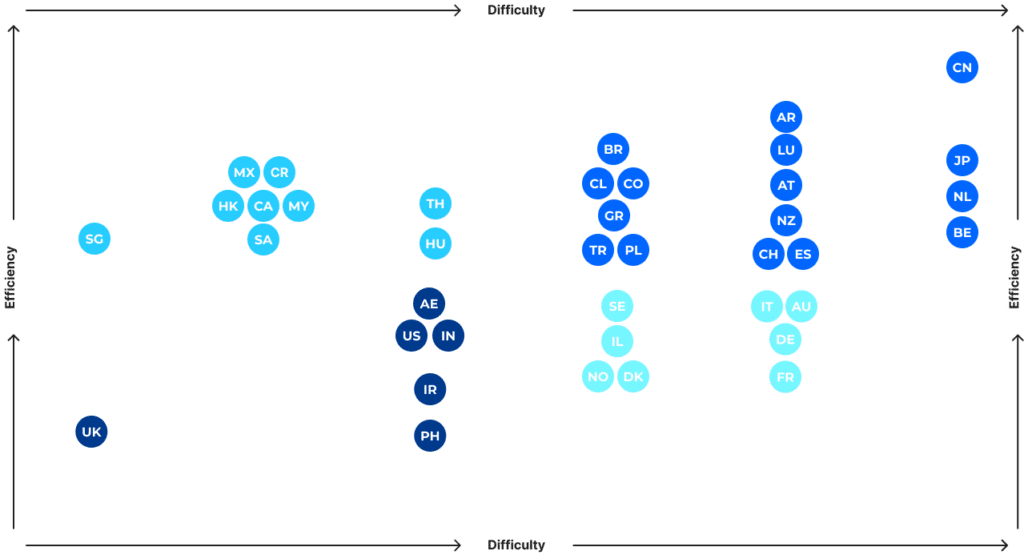
Here are a few examples of country-specific considerations to help inform your global payroll expansion strategy.

Belgium
Belgium is a highly complex country to run payroll due to its multiple legal regulations, high taxes, diverse employment contracts, complex overtime and holiday pay rules – and the need to accommodate three official languages.

Brazil
Brazil, while very efficient, is an extremely difficult country to manage payroll in due to its complex labor laws, unionization, frequent legislative changes, ever-changing employment contracts, and the requirement for managing non-wage benefits. Moving money in and out of the country also puts it high on the complexity matrix.

Singapore
Singapore ranks as the ‘easiest’ country to run payroll in, thanks to its straightforward tax laws, clear regulatory guidelines, advanced digital infrastructure, and streamlined processes for calculating tax and social security contributions.

India
India is a mid-range country in both difficulty and efficiency of running payroll. Despite having payroll technologies considerably, diverse state-specific labor laws and intricate tax structures (alongside multiple tax and employee insurance requirements) limit its ability to accelerate payroll efficiencies.

Sweden
Sweden, while considered one of the more difficult countries to run payroll in due in part to its high tax rates and social security contributions, is bordering on becoming very efficient. With effective government systems and clear regulations in place, continued technology advances are also helping to drive up payroll efficiencies.
73%
of payroll leaders stated ‘keeping up with changing regulations across multiple countries’ was their most impactful compliance challenge.5
Already dealing with country-specific payroll complexity?
Bring it into your business case as a live example and showcase the real-time impact it’s having on your payroll operations..
Work with aligned stakeholders to help build a mini case study to drive home the immediacy of the challenge at hand.

Where to next?
Looking to map out
what’s next?
Explore Envisioning a future state
(Est read time 4 minutes).
Or use the navigation bar to jump to the chapter that matters most to you.
Envisioning the future state
Turning adversity into advantage with unified global payroll.
With pain points identified and both country compliance and complexity mapped out, it’s time to start translating current frustrations into future opportunities. Or to put it another way: it’s show and tell time for your key business stakeholders.
This section of the business case should focus on tracing the journey from your payroll’s ‘as is’ state to its future ‘to be’; comparing the opportunity cost of ‘doing nothing’ with the benefits of transforming to a unified global payroll operation. Doing so will help to bridge the gap for your stakeholders and decision-makers in truly understanding payroll operations and how they impact wider strategic outputs.
To get there, you need to be able to clearly articulate three elements: current challenges, future transformation benefits, and their subsequent impact on the business.
The following page shows a simplified structure used by a CloudPay client during their transformation story, populated with some of the more common challenges and benefits seen when undertaking a global payroll transformation.

Processes
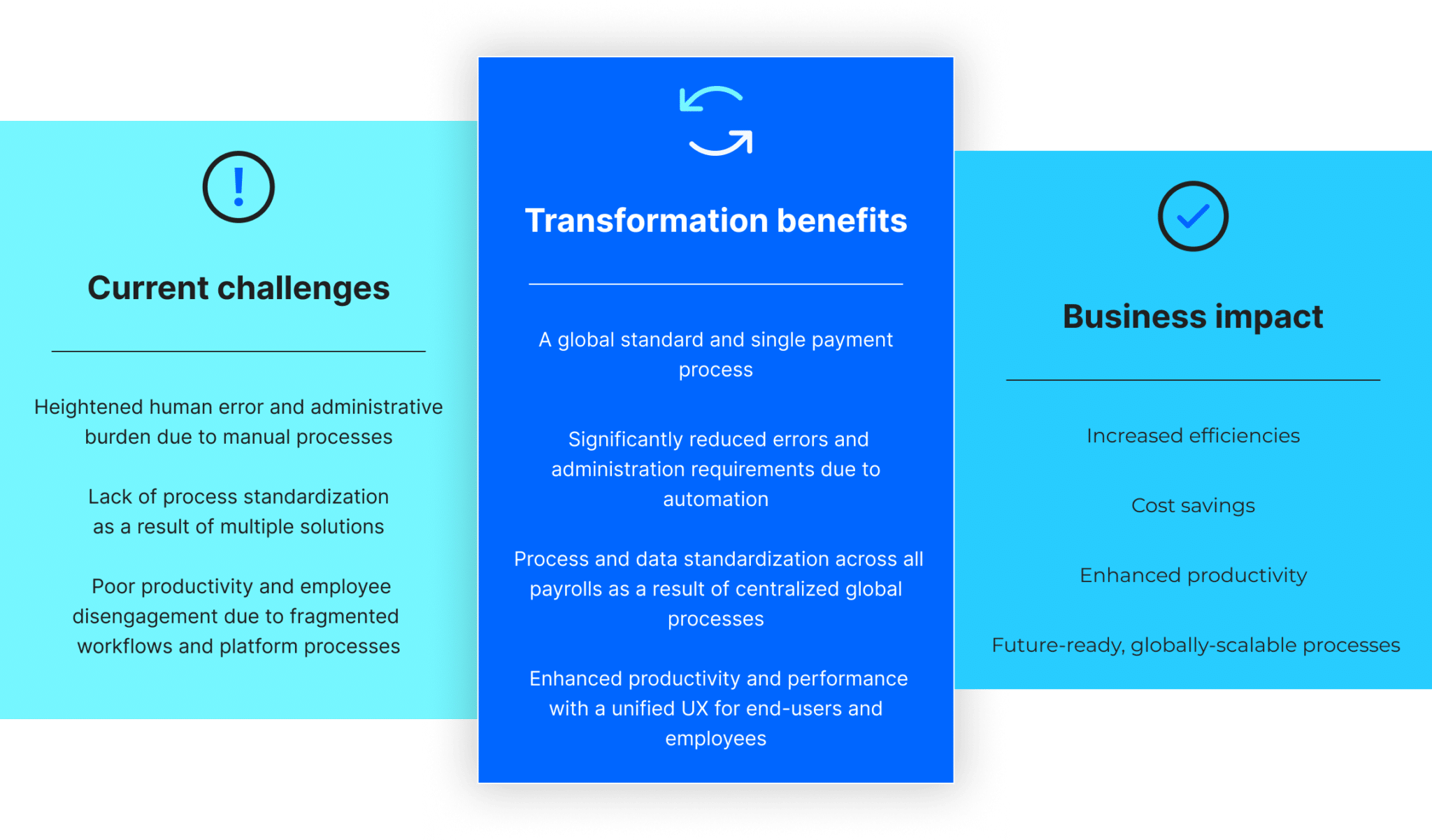
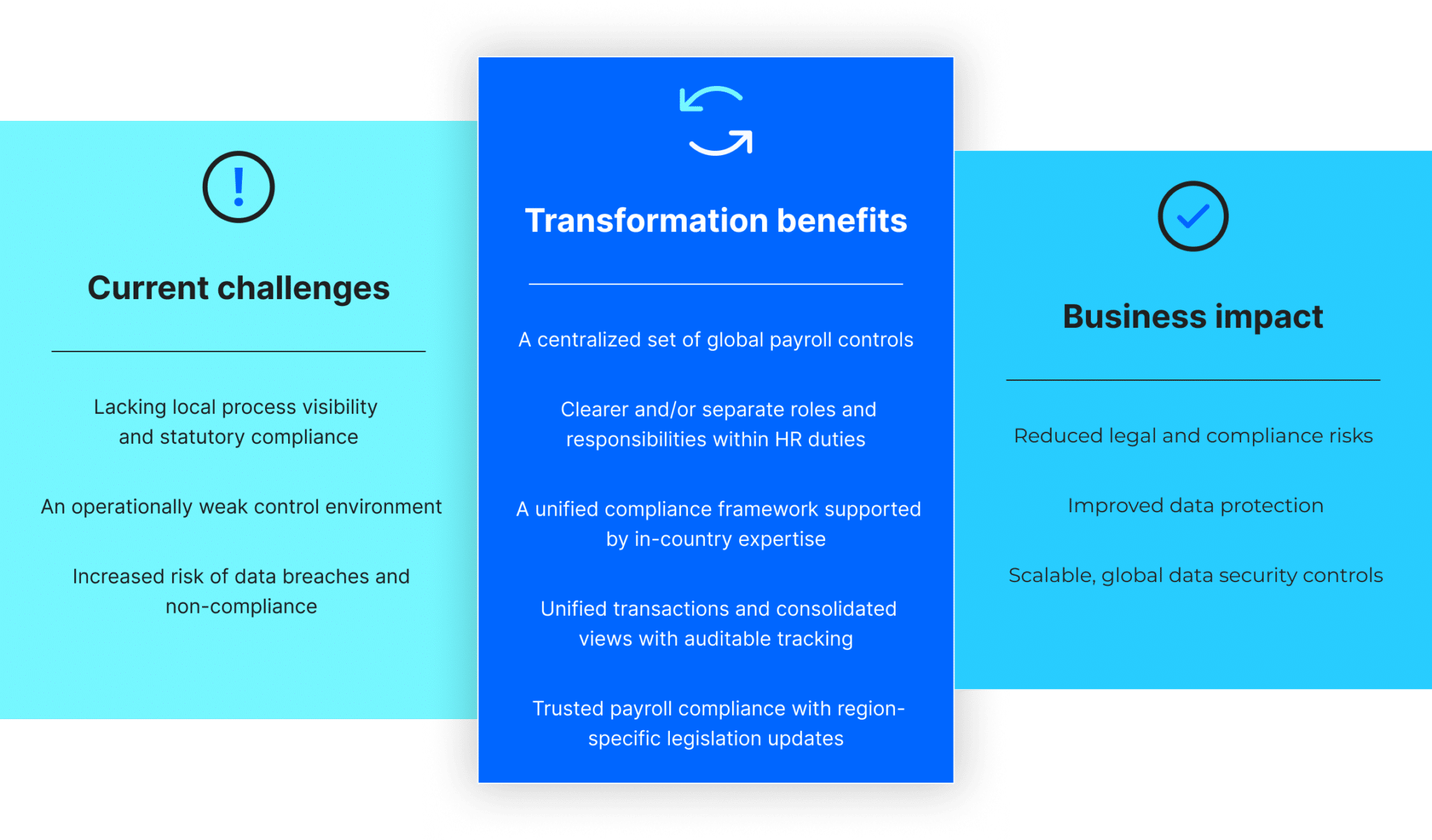
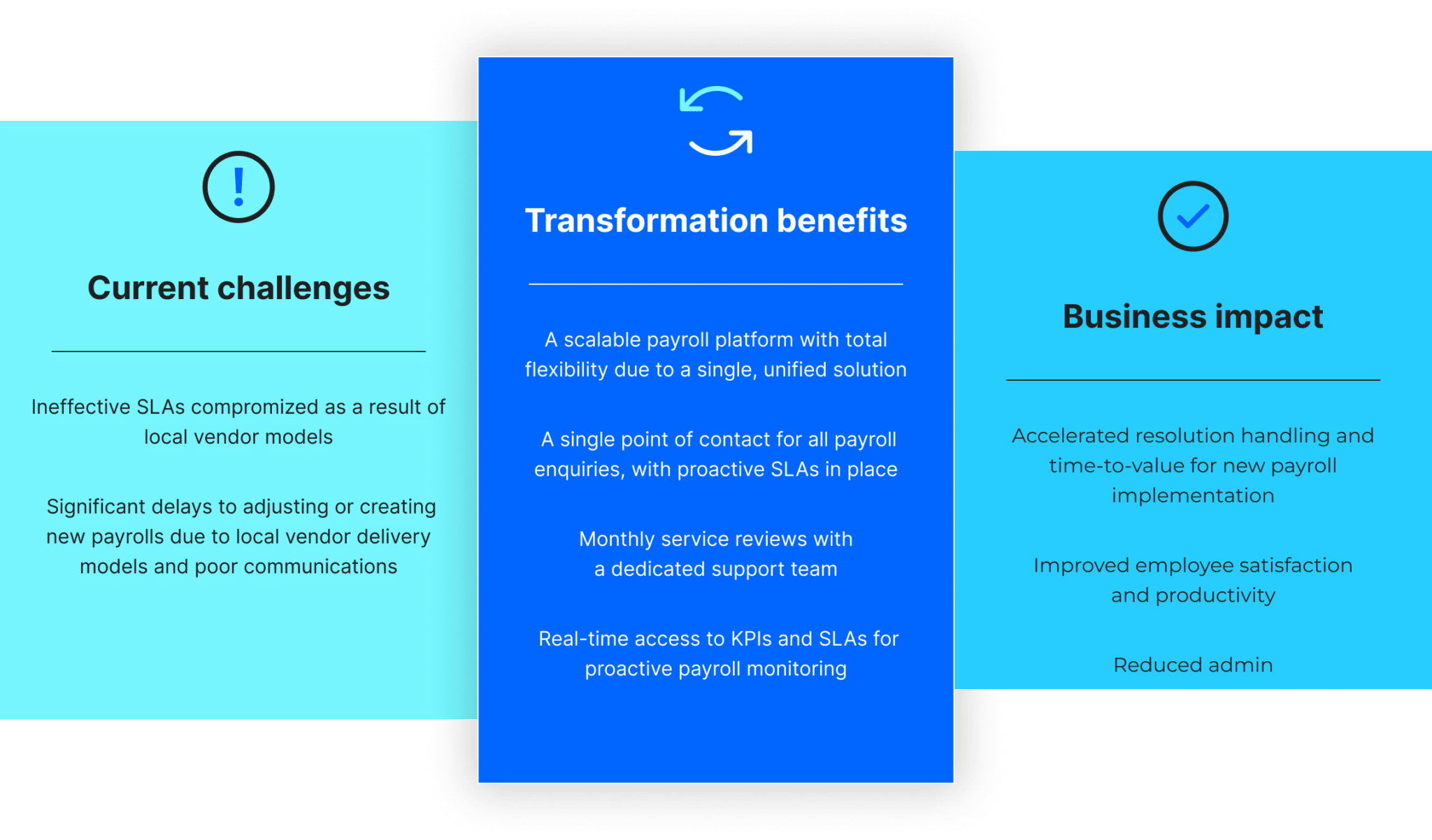
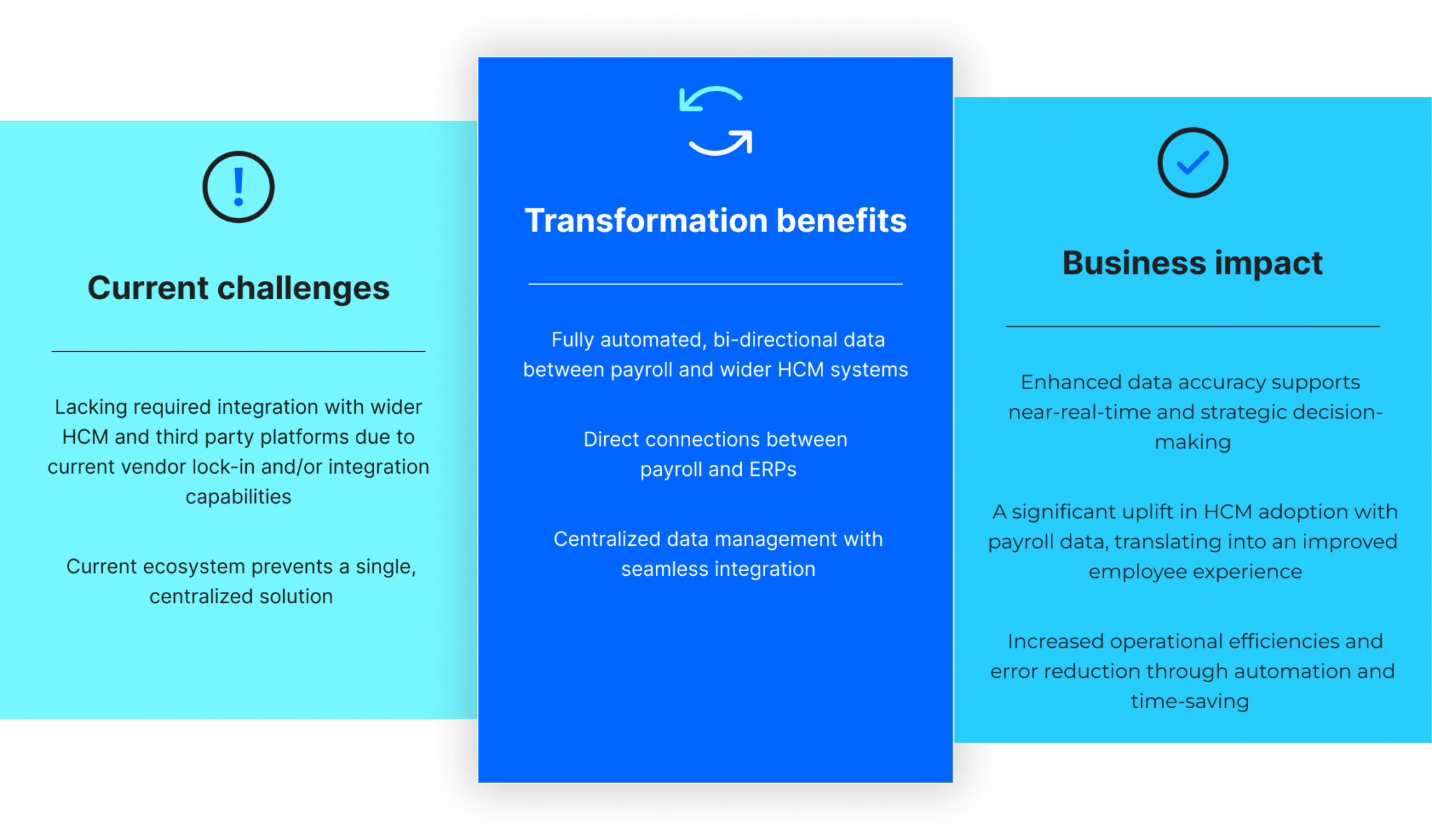
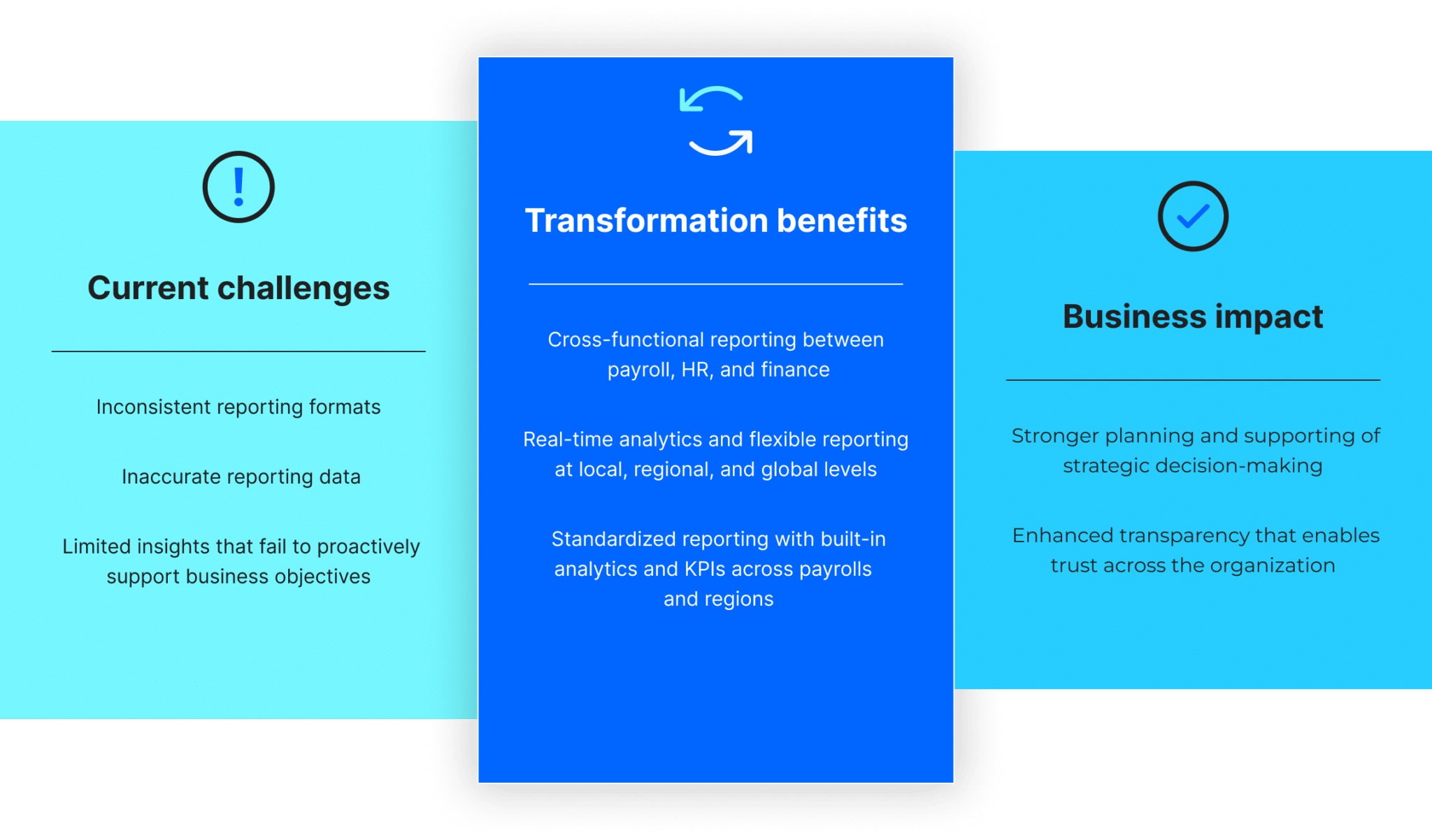
While the challenges, benefits, and impacts used in your own ‘future state’ transformation table will align to your own payroll operations,
the key here is to focus on the priority challenges that align to your organization’s strategic business challenges and work through the transformational benefits and impacts from there.

Where to next?
Ready to see the numbers?
Dive into Quantifying the impact
(Est read time 4 minutes).
Or use the navigation bar above to jump to the chapter that’s right for you, like Implementing the Transformation or Presenting Your Case.
Quantifying the impact
Defining ROI and TCO to drive efficiency gains
Return on investment and time-to-value are essential components for gaining buy-in with any potential global payroll transformation.
As with the mindset when creating a compelling business case, success comes down to how well you align operational efficiency gains with the organization’s strategic business objectives – and at some point, costs are going to raise their heads.
This is, in fact, a fantastic opportunity.
Because defining ROI (Return on Investment) and TCO (Total Cost of Ownership) is not just about how much a potential solution is going to cost – it’s about identifying the wider impacts that can be achieved through business transformation.
Reframing the conversation here allows you to highlight critical operational drivers while simultaneously defining the positive impact on your organization’s bottom line, as well as your people and culture.
Of course, every payroll operation will differ by company and country. Deciding which components to prioritize and highlight is about identifying where your potential transformation will make the most impact.
Here are the most common areas you should explore – and how to best consider their impact:

Standardization of global coverage
Time saving
Compliance and error reduction
Improving decision making visibility
Elevating employee & team experiences
HCM value maximization
What to consider
Consider how your current payroll operation is challenged by:
- Inconsistent access to expert knowledge
- A lack of centralized visibility
- Fragmented platforms complicating the management of (and the ability to scale) operations
Limiting harmonization across operational geographies, reducing consistency and reliability

Potential efficiency gains
Standardizing global payroll operations and consolidating expertise and systems can deliver significant efficiency gains, including:
- Up to 72% faster ticket resolution times via access to in-country experts
- Enhance operational reliability and improved system uptimes
- Exceptional process identification and implementation improvements, with some use cases reporting a reduction in time spent on end-to-end payroll from 11 days to just one day per month
- While efficiency is the most immediate gain, explore how standardization can also influence product roadmaps over time – aligning system evolution with strategic business needs
What to consider
By reconfiguring manual tasks into automated processes, how much time could be saved:
- Gathering payroll data
- Converting data into country-specific formats
- Performing payroll audits
- Manipulating General Ledger data to post to the Payroll Journal
- Triage errors not caught prior to payroll finalization

Potential efficiency gains
Standardizing global payroll operations and consolidating expertise and systems can deliver significant efficiency gains, including:
- Depending on geographical scope and the size of your payroll team, moving to a centralized platform and configuring automations can reduce time spent on manual tasks by between 500-2000 hours per annum
- Identify a cost-per-hour basis for your direct payroll team and multiply this by the total number of projected hours saved to deliver a tangible cost efficiency gainbusiness needs
What to consider
Explore the most commonly occurring errors across your current payroll cycle:
- Incorrect employee information
- Duplicate or incomplete payroll records
- Miscalculating pay and tax
- Wrong tax codes
- Inaccurate benefit calculations
- Overtime calculations
- Late payroll processing and payments
- Missing deadlines

Potential efficiency gains
The average accuracy rate in the global payroll space is approximately 80%; this can increase to 99.8% when partnering with single vendors on a centralized platform.
- According to Ernst & Young, one-in-five payrolls contain errors, with each error costing an average of USD$29166
- Identify your average post-processing cost per-error by multiplying $291 x one-fifth of your total employee headcount
What to consider
Consider how a unified global payroll solution could reconfigure reporting speed and accuracy to enable strategic decision-making with:
- Flexible reporting at global, regional, and local levels
- Built in analytics and KPIs
- Visibility across the entire global footprint
- Removal of manual reporting across disparate tools and data
- Tracking organizational and payroll-specific performance
- Automated General Ledger reporting
Potential efficiency gains
- 41% of organizations don’t track their payroll performance, stifling strategic decision-making capabilities and limiting business innovation
- Identify the global data visibility and reporting bottlenecks within your current payroll operations – speak with functional leads and senior executives to understand the impact these bottlenecks have on their decision-making capabilities
- Tangibly define how accurate and timely reporting through a streamlined global platform could accelerate proactive decision-making at the leadership level

What to consider
Explore current frustrations from both within your payroll team and the wider employee base that are impacting a positive experience, including:
- Self-service portals
- Transparency of earnings and benefits
- Communication strategies
- Instant payment options
- Time-consuming manual processes
- Data inaccuracies
- Calendar visibility and resource planning
Potential efficiency gains
- According to Gartner, only 16% of companies leverage technology to track employee progress and engagement
- Explore how integrating a unified global payroll solution with wider HCM and HR platforms can both unlock new employee engagement insights, while empowering employees with a seamless payroll experience

What to consider
Evaluate the synchronization of your current HCM and payroll systems in the context of supporting strategic HR management and overall business operations, taking into consideration:
- How seamless the flow of data is between HR and payroll systems
- Levels of data integrity and discrepancy
- To what extent these system integrations boost operational transparency, providing HR with real-time access to payroll outputs

Potential efficiency gains
- Integrating HR and payroll systems both streamlines workflows and enhances each system’s independent functionality
- By automating data transfers between systems, administrative burdens
are reduced and manual tasks
largely removed, resulting in:
- A reduction in data errors and duplications
- More accurate payroll processes
- Enhanced reporting capabilities
- Trusted analytics that support proactive decision-making
- The net result? Significant cost-savings and improved operational efficiency – fully unified across both functions
Implementation transformation
Implementing the transformation
Shaping a seamless rollout strategy.
Pain points have been translated into key benefits and strategic impacts. Global complexities and cost efficiencies have been mapped, and your future-state is clearly visualized. Now, you need a clearly defined implementation strategy to bring it all together.
This is the salient point where your key stakeholders and decision-makers will really dial into the detail. While they’ll be looking at time and cost to implementation, you need to go one step further – showcasing a robust rollout strategy that placates cost concerns and delivers valuable output to the business, in a defined time period.
An experienced payroll provider will work with you to build an implementation strategy that does just that – blueprinting a bespoke project plan and overlaying it with clear communications to keep everyone who needs to know, in the know. At CloudPay, we break implementation into six core phases.

“We decided to go with CloudPay based on their customer service model, their flexibility; their global platform and one point of contact. The CloudPay model is instant – I’m literally chatting with my CloudPay representative…they’re right there with you…and that was really important.”
Lisa S. Anderson, Director,
Global Total Rewards, Treasure Data

Key tips!
Start small and then expand. Identify a priority group of countries and/or payrolls to execute an initial implementation with.
Learn, iterate, and apply concepts from there to implement with additional countries. Phase your approach and avoid going
global in one go.
The six stages of implementation
1. Readiness
A dedicated team of Readiness Consultants set up the journey, working with you to establish your scope, current payroll ecosystem, key project success factors (strategic and operational) – and explain CloudPay’s implementation methodology, tools and training.
From there, they finalize and agree a roll-out plan, partnering to trigger light-touch activities – activating the CloudPay portal and learning platform; obtaining country initial templates (PSQs) and sharing your first set of configuration templates.
Once complete, they hand over their risk assessment and recommended migration actions to CloudPay’s onboarding team.
2 Planning
The onboarding team works with you to validate initial data collected, honing-in on specific requirements and identifying areas to drive additional value.
From there, both teams allocate applicable resources and define the most appropriate governance model for delivery.
The project plan is reviewed and refined in partnership, with both teams engaging to commence the onboarding process.
3. Discovery
This is where the deeper dive starts, with CloudPay’s team exploring your old payroll to design the best possible unified pay solution for your agreed needs.
Using questionnaires to capture essential information and prepare project teams for the global scope – including country-specific documents to help prepare local payroll teams – CloudPay’s collaborative calendar tool helps streamline the reviewing and establishing of key milestones and dates for payroll calendars and operational teams.
4. Configuration
In the configuration phase, the project moves to its preparation stage – structuring the CloudPay platform to perform compliance and payroll cycles.
Interfaces are set up and connected into wider HCM-related systems (either using CloudPay’s global automated HCM interface or standardized XML/XLS templates), while the CloudPay system is prepared to receive payroll – including all data, reporting, calendar tools and validation frameworks.
In the background, the CloudPay team is also piecing together the first strategic insights report to support necessary stakeholder updates and commercial conversations.
5. Testing
With the platform configured, it’s over to testing (and we don’t leave things to chance – we mean testing everything).
From data flows and processes to validation checks and reporting, all teams have access to the CloudPay environment where tests and parallel runs are conducted until everyone is satisfied that everything is running smoothly. It’s at this point that CloudPay introduces your Account Success Manager – a dedicated role committed to ensuring complete alignment between your implementation and ongoing service delivery. Your teams are also given access to additional tutorials, guides and information – as well as training certifications – via the CloudPay Academy platform.
6. Deployment
Testing phase results are reviewed and a ‘go/no-go’ decision is made. With sign-off in hand, the green light is given and CloudPay’s unified payroll platform goes live.
At this stage, your Account Success Manager is joined by CloudPay’s wider operations team as part of a formal handover.
Together, they’re responsible for providing a controlled stabilization period, liaising closely to ensure the assigned resources are being utilized.
“What I was able to bring in immediately is tightening up on the financial controls and having a partner that you can work with, communicate effectively with – and get the proper support, all of which is key in getting a successful implementation. That is most definitely what we have with CloudPay.”
Clive Manns, EMEA Payroll Manager, Mitel
The inside line
Read our blog on best practices in change management
Your onboarding
preparation checklist
Ahead of any implementation,
make sure you have:

Secured dedicated resources

Collected all payroll data
Avoided crossover with other transformation projects
Managed existing vendor relationships
Planned a ‘tax-considered’ go-live date
Engaged for change management

Where to next?
Ready to make your pitch?
Dive into Presenting your case
(Est read time 7 minutes).
Or use the navigation bar above to revisit a previous chapter
Presenting your case
Positioning your payroll vision with confidence.
With a clear vision of your payroll future defined, it’s time to secure buy-in from the business. Meticulous planning and strategic communications are critical here; it’s not just what you say – it’s how you present it.
The most compelling business case for payroll transformation when presenting to the business isn’t about the solution – it’s about what the business gains from making the change. To that extent, your proposal needs to resonate on their terms.
CHROs, CFOs, CPOs and CIOs will all have their own agendas, but they share the same strategic interests:


Strategic alignment
Is this transformation the right fit now – does it align with the company’s strategic objectives and help drive growth, scalability and competitive advantage?

Financial impact
From lowering TCO to increasing ROI, what are the financial implications of the proposed transformation – and how does it align with the organization’s wider financial goals?

Risk mitigation
How does the transformation reduce non-compliance and error risks – and how does it enhance data security to protect the company’s reputation and bottom line?

Operational efficiency
How will unified payroll operations improve global processes and streamline operations – and what productivity gains can be expected as a result?

Measurable impact
What does success look like, how will it be measured – and how should the impact of the transformation be evaluated over time?

Stakeholder benefits
From department-specific impacts to the wider employee experience, how will the transformation benefit different stakeholder groups – and what disruption could it cause in the short term?
“What I was able to bring in immediately is tightening up on the financial controls and having a partner that you can work with, communicate effectively with – and get the proper support, all of which is key in getting a successful implementation. That is most definitely what we have with CloudPay.”
Clive Manns, EMEA Payroll Manager, Mitel

Framing your proposal with these strategic objectives in mind not only positions the case for transformation in light of the benefits it brings to the organization – it sets the tone for a discussion based on value over cost.
How you go on to structure the subsequent business case is just as important. While demonstrating the future vision is key, make sure to not get carried away – break the timeline down and showcase the integrity of your planning.
Implementing a payroll transformation is a phased approach involving multiple stages, stakeholders and countries; buy-in becomes easier and perceived risk reduces when you can show clear control on cost and timelines.
The essential components of a persuasive business case
Executive summary
Provide an overview of what’s being proposed, summarizing the key objectives, benefits and recommendations.
Strategic alignment
Clearly define how the proposed payroll transformation aligns with the organization’s strategic goals and objectives.
Business objectives
Outline the specific objectives that the transformation aims to achieve, including the likes of cost reduction, process efficiency, global compliance, and improved employee experience.
Financial analysis
With support from finance, include a cost-benefit analysis to detail projected savings, ROI and payback periods.
Risk assessment
Identify potential risks and challenges that transformation may expose the business to, alongside mitigation strategies to minimize impact.
Stakeholder impact
Detail how the transformation is likely to impact stakeholders external to direct payroll teams, including HR, finance, IT and legal departments.
Implementation plan
Put those hard yards to good use and breakdown the transformation’s phased project approach, including timelines, milestones, resource requirements and third party support.
Change management
Outline the change management strategy and communication plans to support the smooth transition for employees and stakeholders onto the new payroll system.
Technology infrastructure
Highlight the infrastructure needed to support the new payroll system, considering other software platforms, integrations and security measures.
“The beauty of using CloudPay is that you streamline the amount of contacts that you have…with one CloudPay system that you enter the data in. The other thing is their Treasury Services; I find that a great help …and I can pay anyone across Europe and CloudPay will take care of all of that for me.”
Stephen Dring, EU Payroll Director, VISA

Identify your advocates
Undertaking a global payroll transformation is a significant and collaborative effort. As a payroll leader, securing the right stakeholder support to champion this change is essential. It’s equally important to know how and when to engage these key business stakeholders and decision makers throughout the transformation process.
From gathering insights and exploring pain points, to ensuring alignment and sense-checking concerns, here are the key departments you should engage with throughout the process:

HR

Finance

IT

Legal Compliance

Data Protection
With deep insights into workforce management and employee needs, HR is the nucleus of all things people-related. Collaborating with key HR stakeholders helps align payroll processes with employee experience, compliance, and wider strategic operational goals across the business.
When to engage them
From the outset to identify employee pain points and requirements, and continuously throughout the process to ensure a smooth implementation and support in helping employees adapt to operational changes.

With exceptional strategic knowledge and a solid global view of the business, collaborating with finance helps with identifying cost-saving opportunities, ROI analysis and potential budget allocation.
When to engage them
Early on for initial pain point discovery, then later in the process for ROI and cost-benefit analysis.

As in-house experts in system integrations and existing technology infrastructure, collaborating with IT helps identify potential tech-related challenges upfront and throughout the process, accelerating software and system integrations while reducing technical inefficiencies.
When to engage them
After HR and early on to assess technical requirements and feasibility, then at agreed and consistent milestones for system integration, testing, troubleshooting, and updates.

Well-versed in navigating regulatory requirements and privacy laws across multiple countries, collaborating with legal and compliance departments helps with guidance on regulatory implications, risk mitigation strategies and insights into contractual obligations with current payroll vendors.
When to engage them
Early on to map out country-specific compliance, and stay close throughout the process for ongoing collaboration.

Tied in closely with legal and compliance, the Data Protection Officer is critical in advising on data privacy laws, providing data impact assessments and helping to implement appropriate data protection measures. They’re your data and security go-to for any and all advice.
When to engage them
From day one to assess existing risks, vulnerabilities and opportunities, then throughout the entire project lifecycle.

External collaboration is key, too…
Your chosen global payroll provider should be with you every step of the way. From helping you to identify initial pain points and scope potential plans – to advising on best practice and sharing insights on navigating compliance complexities.
Utilize this support to refine and validate your strategy, ensuring it resonates with key business stakeholders and decision makers.

Where to next?
Ready to see the numbers?
Explore Getting buy-in for global payroll transformation
(Est read time 2 minutes).
Or use the navigation bar above to jump to Talking to an Expert for personalized insights.
Getting buy-in for global payroll transformation
Investing in a truly global, unified end-to-end payroll solution is about more than optimizing operational efficiency (as important as that is) – it’s about becoming a strategic enabler for the organization.
It’s about setting up for seamless scalability; it’s about accelerating opportunities. It’s about driving decisions in the present that unlock future growth. To get there, it’s about building a business case that gets buy-in from day one.
Here are the top things to keep in mind as you do so…

Prioritize pain points that impact productivity and profitability
Highlight cost savings and emphasize how your intended transformation can significantly reduce operational costs and mitigate financial risks – directly impacting the bottom line – through automation, vendor consolidation, and improved compliance.


Showcase the real-world value of real-time insights
Moving to a unified global payroll solution isn’t just about enhancing operational speed and efficiency – it’s about improving strategic decision-making and future scalability.
Demonstrate how the transformation can support this with accurate, real-time insights through a single ‘source of truth’ to unlock new opportunities, and you’ll get stakeholders thinking critically about your business case.
Think strategic objectives first, operational outcomes (a close) second
From standardized processes and faster payroll cycles to centralized data management and instant payments, ensure operational outcomes connect back to the organization’s strategic growth and scalability goals. This is where interest turns into attention, which you want to translate into buy-in.

Take control of your time and get ahead in your global payroll vendor evaluation, with CloudPay’s specialized RFP guide and template – a framework for creating a comprehensive and well-structured RFP for your payroll services.

Are you ready to start your global payroll transformation with a business case that gets buy-in?
Schedule a consultation call with one of our CloudPay experts and discover how we can help unify your payroll across 140+ countries.
References
- ‘Reaping the Benefits of Unified Pay Solutions’, Everest Group, 2024 ↩︎
- ‘Reaping the Benefits of Unified Pay Solutions’, Everest Group, 2024 ↩︎
- Global Payroll Benchmarking Survey, Deloitte, 2020 ↩︎
- The Tech-Talent Equilibrium, CloudPay, 2024 ↩︎
- ‘Lead your organization to payroll compliance mastery’ webinar, CloudPay & GPA, 2024 ↩︎
- Cost and risks due to payroll errors, EY, 2022 ↩︎